Lately, I have had a fascination with watching Robert Downey Jr. movies. I’d forgotten how much I love him as an actor until I picked up Kiss Kiss Bang Bang and threw it into my DVD player a few months ago. Now I am obsessed. Since I opened a Netflix account and now have access to everything I added most of Downey’s catalog and Christian Bale’s to my queue. The latest Downey film I received is A Guide to Recognizing Your Saints.
The film is autobiographical about the life of the director/writer of the film and book - Dito. In the film Dito is played by Robert Downey Jr. in the 2005 time line and Shia LaBeouff in the 1986 time line. In the present Dito has just written the book about his life as a teen in Queens and why he left, and his mother gives him a call because his father is sick and won’t go to the hospital so she wants Dito to attempt coming home and taking him. Dito left home in 1986 and hasn’t been back since. The film recounts the events that led up to Dito fleeing home in the flashbacks with Shia LaBeouf.
I enjoyed this movie, but I don’t think that it is one that will appeal to the mass audience. The director has chosen to add some experimental elements into the film that won’t sit well with a large portion of the audience. There is subtitles put in the film when they would not normally be necessary, portions are edited similar to The Limey where you flash forward and backward with characters during a conversation so you don’t see them speaking while you hear them conversing, and the fourth wall is broken multiple times.
It is my opinion that this film worked in this format because it was made by the author of the book. It is obviously not a faithful adaptation to the entire book, but rather focuses on something very specific that Dito needed to work through – his relationship with his father and the life that he wanted for his son. This is actually one movie that really makes me want to learn more about the man behind it and read the book.
Director & Writer: Dito Montiel
Dito: Robert Downey Jr.
Young Dito: Shia LaBeouf
Flora: Dianne Wiest
Laurie: Rosario Dawson
Young Laurie: Melonie Diaz
Diane: Julia Garro
Jenny: Elenore Hendricks
Guiseppe: Adam Scarimbolo
Nerf: Scott Campbell
Young Nerf: Peter Tambakis
Antonio: Eric Roberts
Young Antonio: Channing Tatum
Monty: Chazz Palminteri
Mike: Martin Compston
Frank: Anthony DeSando
Dito: In the end - just like I said - I left everything, and everyone. But no one, no one has ever left me
Showing posts with label the limey. Show all posts
Showing posts with label the limey. Show all posts
Thursday, September 25, 2008

Wednesday, August 6, 2008
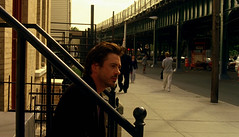
The Limey
The Limey is one of the most confusingly told tales I have ever seen committed to film. I’m not saying that the film is indiscernible, but they way in which Steven Soderbergh chose to weave the film together is one of the most unique things I have ever seen. I have spent the better part of my time since watching the film last night trying to understand the flow of the film, and have decided that to do so would consist of at least 3-4 consecutive views of the film. While the film would be worth this degree of study, I simply don’t have the time as I am no longer a film student.
Part of what fascinates me about The Limey is that the story is one of the most basic concepts that can be imagined, yet the way it is put together gives it a layer of complexity and meaning that would not otherwise be ascribed to the text.
The tale is one of revenge, plain and simple. Wilson is a career criminal who has just been paroled after 9 years in prison and has been informed that his daughter Jenny was killed in a car accident in California; however, that the circumstances of the accident seem a little too perfect to be random. Saddened and fueled by a new mission, Wilson comes to America to seek out more information on his daughter’s life here and realizes that her live-in boyfriend, music producer Terry Valentine is the likely culprit of her death and is able to track down the illegal dealings that lead to Jenny’s unfortunate passing. Wilson has one goal: make Terry suffer for his daughter and take out anyone that gets in the way.
What makes The Limey so unique is not only its utter lack of subplots, but the way past, present and future are laid out. When watching the film the audience is never sure if what they are seeing is a flash forward, flashback, the character’s imagination or present time; all of these elements are cut together at any given time, and repeated multiple times until they create the psychological underpinnings that take Wilson from being a one dimensional character to a complex & conflicted protagonist.
I have several theories about the images that are shown, the visual clues Soderbergh creates, and the actual timeline of the film, but I am not comfortable sharing them without at least one more viewing of the film under my belt.
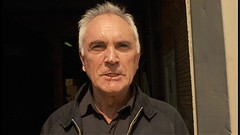
Perhaps what stood out to me most is Terence Stamp as the character of Wilson. The first few minutes all I could think of was “this is Zod from Superman II”, but that quickly faded and I was immersed in Wilson and his world. If his acting in the film weren’t half as good as it is, you would still have to applaud him for his ability to deliver his lines using the confusing Cockney rhyming slang that allows his character to be such a puzzling entity to the American’s in the film. The use of this vernacular adds to the confusing nature of the film and underscores Wilson’s differences between he and the people around him, and for the educated linguist makes him a more credible British criminal.
The Limey is not an easy film to watch. In fact, it’s one of the only film that I can think of in recent memory that I was actually uncomfortable watching for the first 10-20 minutes simply because I could not figure out how the story was unfolding and what the images meant. However, to a person who appreciates cinema and the language used to create it, The Limey is an essential film to have under your belt and much easier to stomach than a Bergman film.
Director: Steven Soderbergh
Writer: Lem Dobbs
Wilson: Terence Stamp
Elaine: Lesley Ann Warren
Eduardo: Luiz Guzman
Stacy: Nicky Katt
Terry Valentine: Peter Fonda
Adhara: Amelia Heinle
Jenny: Melissa George
Wilson: [peering over railing] What are we standing on?
Ed: Trust?
Part of what fascinates me about The Limey is that the story is one of the most basic concepts that can be imagined, yet the way it is put together gives it a layer of complexity and meaning that would not otherwise be ascribed to the text.
The tale is one of revenge, plain and simple. Wilson is a career criminal who has just been paroled after 9 years in prison and has been informed that his daughter Jenny was killed in a car accident in California; however, that the circumstances of the accident seem a little too perfect to be random. Saddened and fueled by a new mission, Wilson comes to America to seek out more information on his daughter’s life here and realizes that her live-in boyfriend, music producer Terry Valentine is the likely culprit of her death and is able to track down the illegal dealings that lead to Jenny’s unfortunate passing. Wilson has one goal: make Terry suffer for his daughter and take out anyone that gets in the way.
What makes The Limey so unique is not only its utter lack of subplots, but the way past, present and future are laid out. When watching the film the audience is never sure if what they are seeing is a flash forward, flashback, the character’s imagination or present time; all of these elements are cut together at any given time, and repeated multiple times until they create the psychological underpinnings that take Wilson from being a one dimensional character to a complex & conflicted protagonist.
I have several theories about the images that are shown, the visual clues Soderbergh creates, and the actual timeline of the film, but I am not comfortable sharing them without at least one more viewing of the film under my belt.
Perhaps what stood out to me most is Terence Stamp as the character of Wilson. The first few minutes all I could think of was “this is Zod from Superman II”, but that quickly faded and I was immersed in Wilson and his world. If his acting in the film weren’t half as good as it is, you would still have to applaud him for his ability to deliver his lines using the confusing Cockney rhyming slang that allows his character to be such a puzzling entity to the American’s in the film. The use of this vernacular adds to the confusing nature of the film and underscores Wilson’s differences between he and the people around him, and for the educated linguist makes him a more credible British criminal.
The Limey is not an easy film to watch. In fact, it’s one of the only film that I can think of in recent memory that I was actually uncomfortable watching for the first 10-20 minutes simply because I could not figure out how the story was unfolding and what the images meant. However, to a person who appreciates cinema and the language used to create it, The Limey is an essential film to have under your belt and much easier to stomach than a Bergman film.
Director: Steven Soderbergh
Writer: Lem Dobbs
Wilson: Terence Stamp
Elaine: Lesley Ann Warren
Eduardo: Luiz Guzman
Stacy: Nicky Katt
Terry Valentine: Peter Fonda
Adhara: Amelia Heinle
Jenny: Melissa George
Wilson: [peering over railing] What are we standing on?
Ed: Trust?
Subscribe to:
Posts (Atom)